
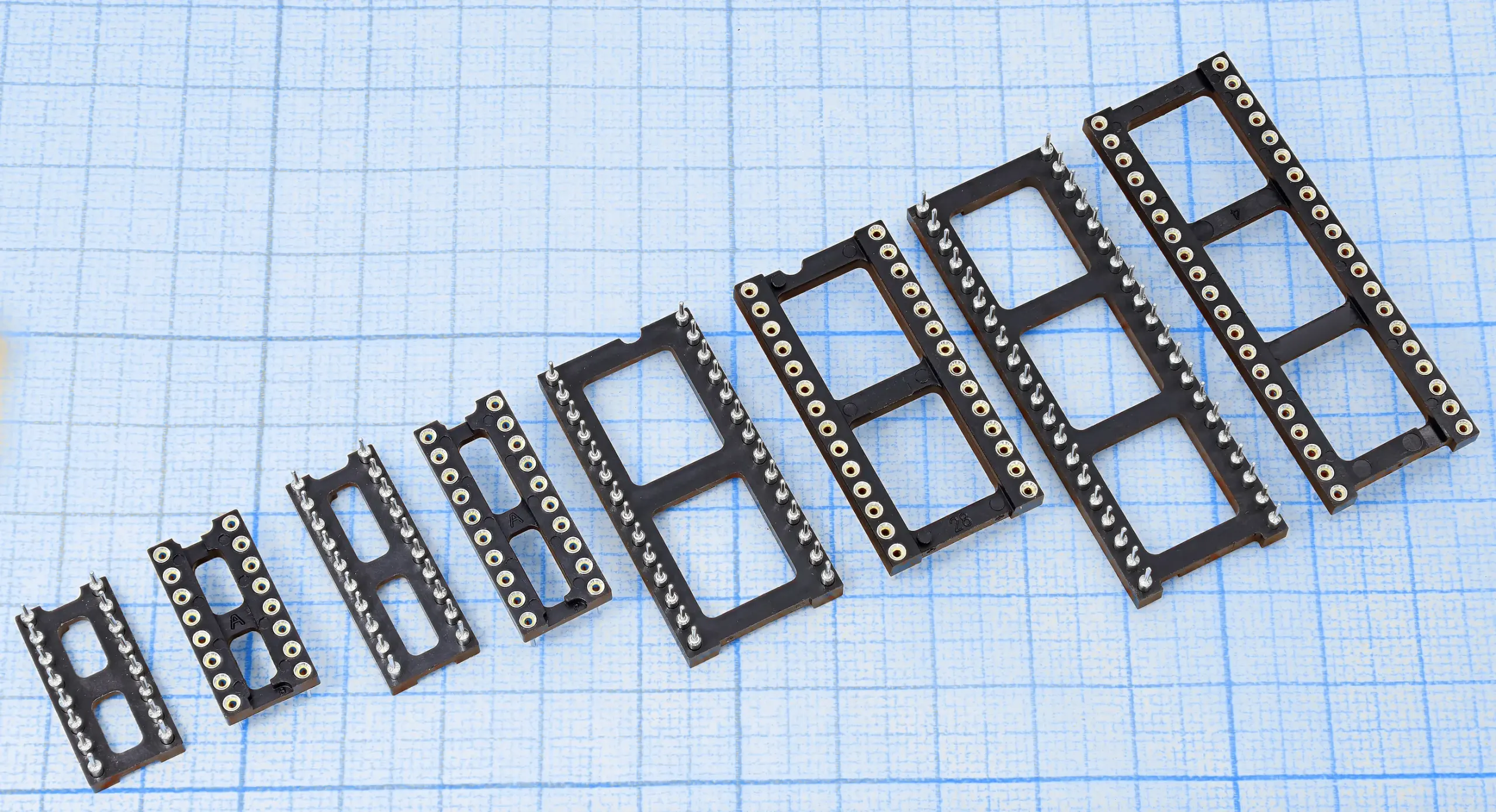
Why are IC sockets used?
- Replacement: a socketed chip can be swapped in seconds, without heating the board.
- Programming and updates: chips such as EPROMs and some microcontrollers can be removed, reprogrammed and refitted.
- Prototyping and testing: different chips can be tried in the same position.
- Protection: the IC is never exposed to soldering heat.
The trade-offs: a socket adds height, cost and an extra connection, and in equipment that vibrates a chip can work loose over time. Production boards often solder ICs directly for that reason.
How does a socket relate to its IC?
A socket mirrors the IC’s pins. It has to match three things: the package style, the number of pins and the spacing between the rows.
For a replacement socket, count the positions on the old socket rather than the pins on the chip — boards are occasionally designed with a larger socket than the chip fitted in it.
What is a DIP socket?
Most IC sockets are for DIP (dual in-line package) chips: two parallel rows of pins, 2.54 mm (0.1 inch) apart, fitted through holes in the board.
Row spacing
The distance between the two rows is usually 7.62 mm (0.3 inch), called narrow, or 15.24 mm (0.6 inch), called wide. Smaller DIPs are generally narrow; many larger chips are wide, and some pin counts come in both. Measure the row spacing or check the IC’s datasheet.
Contact type
| Stamped (dual-wipe) | Machined (turned-pin) | |
|---|---|---|
| Contacts | Formed from flat metal strip | Precision-turned round contacts |
| Grip and wear | Good for occasional insertion | Generally firmer grip; stands up to repeated insertion |
| Typical use | General-purpose and cost-sensitive boards | Prototyping, testing and demanding equipment |
| Cost | Lower | Higher |
Other kinds include zero-insertion-force (ZIF) sockets, used where chips are changed often, and sockets for PLCC chips. For these, send the chip’s package and pin count.
How do I choose the pin count?
Match the pin count to the IC — an 8‑pin chip needs an 8‑pin socket, a 16‑pin chip a 16‑pin socket. DIP sockets come in even pin counts, because the pins are split equally between two rows.
Count the pins on both sides. Pin 1 is next to the notch or dot on the IC, and the pins are numbered anticlockwise from there when viewed from the top, so the highest number sits opposite pin 1.
Line up the notch on the IC with the notch on the socket and the pin-1 mark on the board. Fitted backwards, a chip can be damaged at power-up.
Will any IC fit a DIP socket?
Only through-hole DIP chips. Surface-mount ICs such as SOIC and QFP solder directly to the board; sockets for them are specialised and not interchangeable with DIP sockets. See How to identify an IC for the common packages.
Using sockets for replacement and prototyping
- Replacing a socket: desolder the old one carefully, and match its pin count, row spacing and contact type.
- Adding a socket during a repair: check there’s height clearance above the board — the chip will sit higher.
- Prototyping: machined sockets cope better with chips being inserted and removed repeatedly.
Solder the socket first, then insert the IC once the board has cooled.
What information do buyers need to provide?
- The IC’s part number, or its package.
- The pin count.
- The row spacing: narrow (0.3 inch) or wide (0.6 inch).
- The contact type, if you have a preference: stamped or machined.
- The quantity, and a photo of the old socket for a replacement.
V Bright Electronics India deals in IC sockets and integrated circuits. Send the pin count, row spacing and quantity.
Key takeaways
- A socket lets an IC be removed and replaced without soldering.
- Match the package, pin count and row spacing to the IC.
- Narrow DIP rows are 0.3 inch apart; wide rows 0.6 inch.
- Machined contacts suit repeated insertion; stamped ones are economical.
- Line up pin 1 — the notch or dot — with the socket and board.