
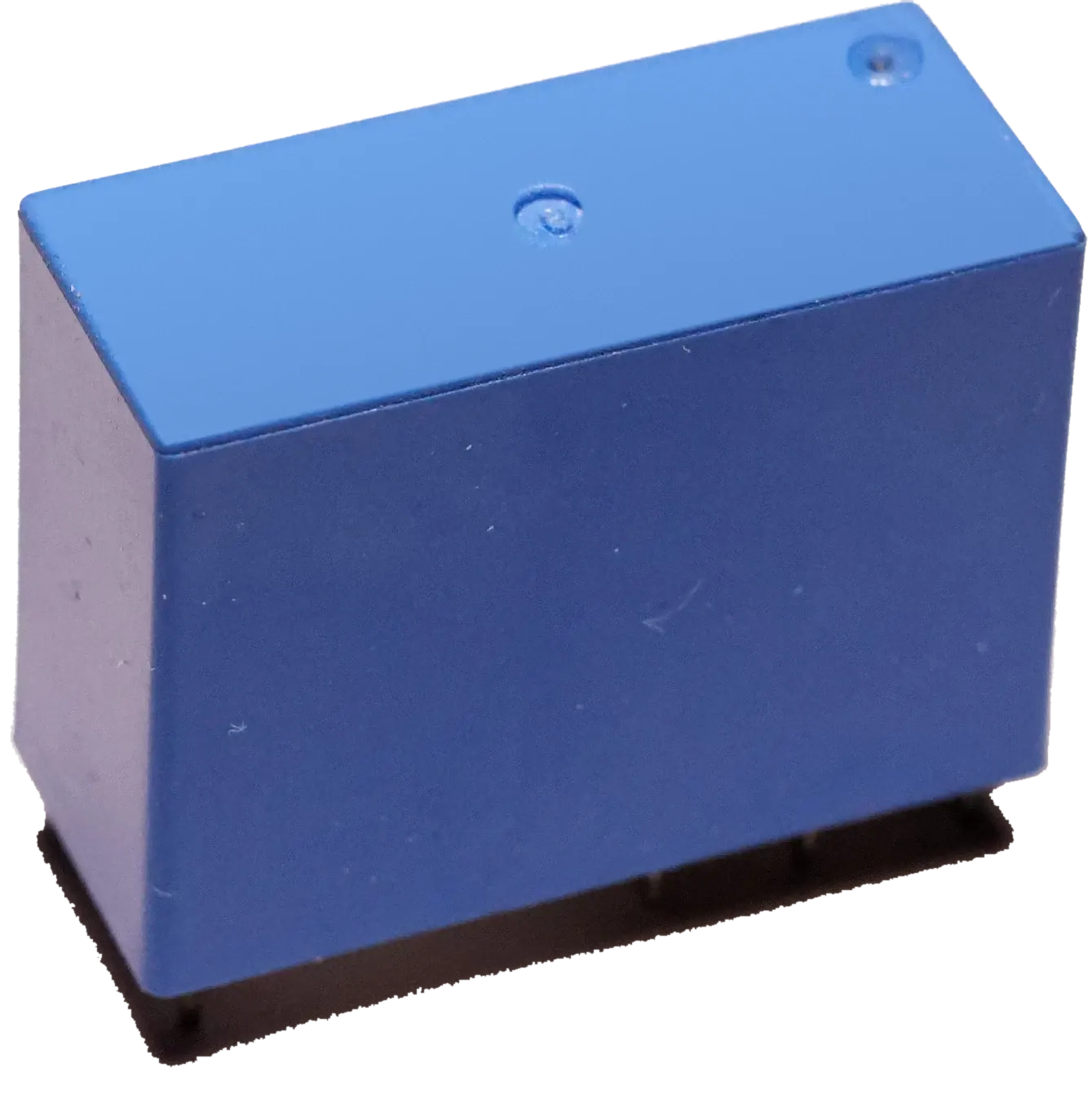
What does a relay do?
A relay is an electrically operated switch. A small current through its coil creates a magnetic field that moves the contacts, so a low-power control circuit — a microcontroller, timer or thermostat — can switch a separate, often much larger, load.
Because the coil and the contacts aren’t electrically connected, a relay also isolates the control side from the load side.
What does coil voltage mean in a relay?
Coil voltage is the voltage the coil is designed to be driven with to switch reliably. It has to match your control circuit: a 12 V relay on a 5 V supply may not switch, and a 5 V relay on 12 V will overheat.
- Common DC coil voltages include 5 V, 12 V and 24 V; AC coils are made for mains-voltage control.
- AC and DC coils are not interchangeable — check which one you have.
- Note the coil current or resistance. A microcontroller pin usually can’t drive a coil directly, so a transistor or driver is used.
When a DC coil switches off it produces a voltage spike, which is why a diode is normally fitted across it — see How to choose the right diode.
What contact arrangement do I need?
The contact arrangement describes how many circuits the relay switches, and how.
| Arrangement | Also written | What it does |
|---|---|---|
| SPST-NO | 1 Form A | One circuit, open until the coil is energised |
| SPST-NC | 1 Form B | One circuit, closed until the coil is energised |
| SPDT | 1 Form C, changeover | One common contact that switches between two |
| DPDT | 2 Form C | Two changeover circuits, switched together |
NO means normally open and NC normally closed — the state with the coil off. The pin diagram, often printed on the relay’s case, shows which pin is which.
What load can the relay switch?
The contact rating — a current at a stated AC or DC voltage — is the most the contacts are designed to switch. Check it against both the voltage and the current of your load.
- DC is harder to switch than AC: a relay’s DC rating at a given voltage is often lower than its AC rating.
- Motors, transformers, lamps and LED drivers draw a surge at switch-on that can be several times their running current. Allow margin for it.
- Don’t switch a load above the rating, even briefly — it wears or welds the contacts.
When a relay switches LED lighting or a power supply, check the driver’s inrush current where its datasheet lists it, and choose a relay rated for it.
Which mounting or package?
- PCB relays: pins soldered into the board. The pin layout must match — relays with the same ratings can have different pinouts.
- Plug-in relays: fit a matching socket or base, common in control panels.
- DIN-rail relays and modules: clip onto a rail inside a panel.
- Solid-state relays: switch electronically with no moving contacts. They suit frequent switching, but have their own ratings and heat to manage.
How do I find a replacement relay?
Most relays print their part number, coil voltage and contact ratings on the case. Read all of it.
- The complete part number.
- The coil voltage, and whether it’s AC or DC.
- The contact rating and arrangement.
- The pin layout — a photo of the underside helps.
- The body size, if it has to fit a fixed space.
Match the footprint as well as the ratings. A relay with the right coil and contacts but a different pin layout won’t fit the board.
What to share when enquiring for relays
- The part number, if there is one.
- The coil voltage, AC or DC.
- The contact arrangement.
- The load: its voltage, current and type (resistive, motor, lighting).
- The mounting: PCB, plug-in or DIN rail.
- The quantity, and photos for a replacement.
V Bright Electronics India deals in relays, and in power supplies and drivers for lighting and electronic requirements.
Key takeaways
- Match the coil voltage — and AC or DC — to the control circuit.
- Choose the contact arrangement the load needs: NO, NC or changeover.
- The contact rating must cover the load, including switch-on surge.
- Match the pin layout as well as the ratings for PCB relays.
- The relay’s case usually carries everything needed for a replacement.