
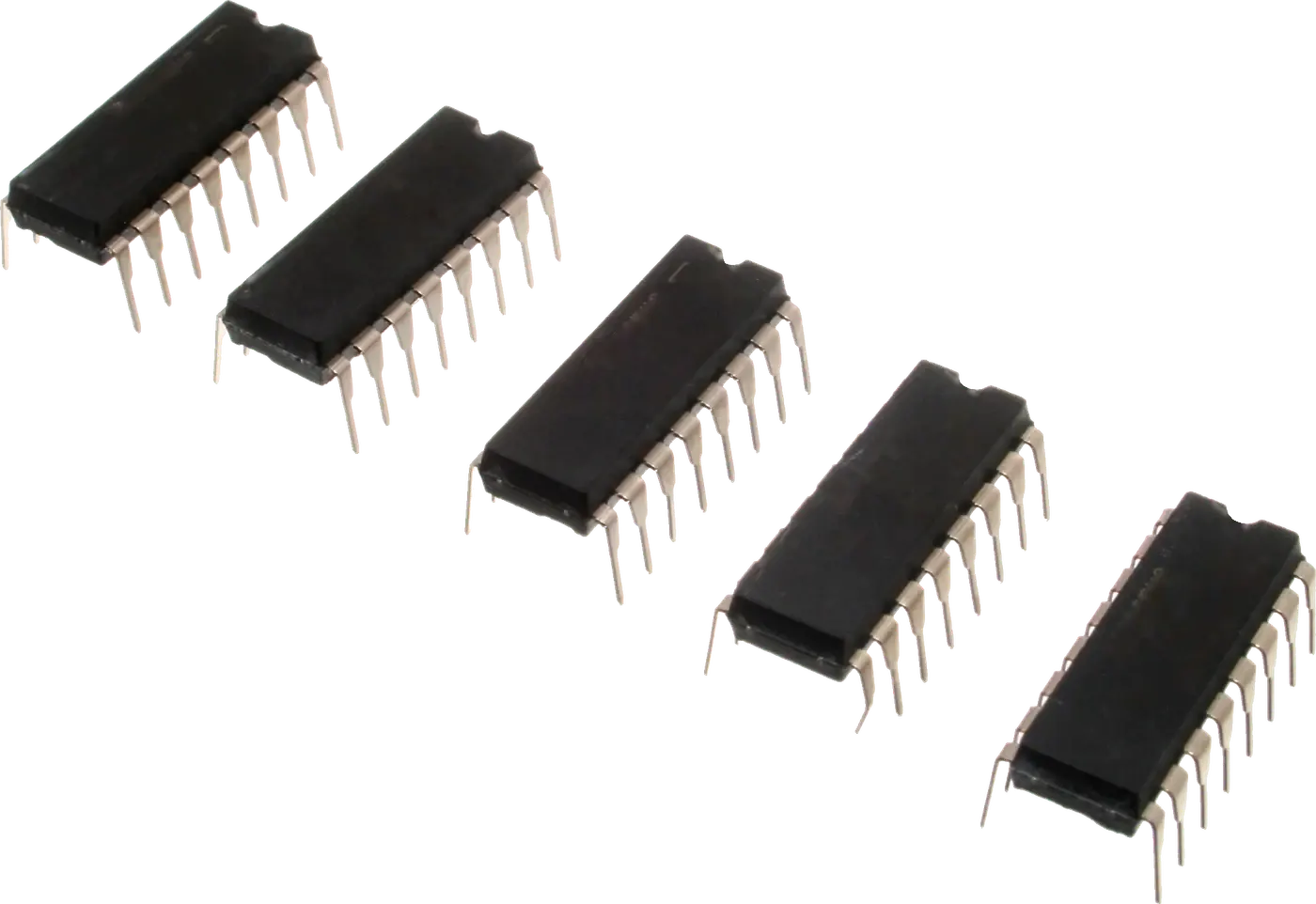
What do the markings on an IC mean?
Most ICs carry several lines of text. Exactly what each line means varies by manufacturer, but the markings usually include:
- The part number — the code that identifies the device and, often, its variant.
- A manufacturer logo or code.
- A date or lot code — when and where the chip was made. It identifies the batch, not the part.
- Sometimes a country of origin or other production codes.
For identification, the part number is the line that matters. Date and lot codes change from batch to batch and don’t identify the device.
Why does the complete part number matter?
The core of a part number identifies the device, but the characters around it often change something important: the package, the temperature range, a speed or voltage grade, or the lead finish. Two chips that share the same core number may not be interchangeable.
- Send every character of the part number, in order.
- Don’t drop prefixes or suffixes, even if they look like packaging codes.
- If a datasheet or BOM lists the full ordering code, send that too.
Is the marking always the same as the part number?
Not always. Small packages don’t have room for a full part number, so manufacturers print a short marking code instead. That code alone may not identify the part — the same short code can mean different devices from different makers.
If the marking is very short, send the package type, the number of pins, photos, and the board or equipment the chip came from. The circuit diagram or BOM is the most reliable reference.
Why does the package type matter?
The same device is often made in several packages, and the package must match the board footprint or socket.
| Package | What it looks like | Typically used for |
|---|---|---|
| DIP (dual in-line) | Two rows of pins through the board, 2.54 mm apart | Hand assembly, sockets, repair |
| SOIC | Surface-mount, with leads along two sides | Compact boards, machine assembly |
| SOT | Very small surface-mount, three to six leads | Regulators, small logic and analogue parts |
| QFP | Leads along all four sides | Microcontrollers and larger ICs |
| QFN / DFN | No leads; pads underneath | Very compact designs |
Count the pins, note whether they pass through the board or sit on its surface, and measure the body if you can. DIP ICs can sit in IC sockets — see IC sockets explained.
What if the marking is worn or only partly visible?
Don’t guess missing characters — a single wrong letter can point to a different device.
- Photograph the chip straight on, in good light, with the text in focus. Tilting it slightly towards the light can bring out laser-etched text.
- Write down exactly what you can read, using * for each unreadable character.
- Check other sources: the circuit diagram, service manual, BOM, or an identical board.
- Note what the board does and what the chip connects to — it narrows the search.
Sometimes markings are removed deliberately. Then the circuit diagram, the BOM or the equipment manufacturer is the only reliable source.
How should I photograph an IC for identification?
- A close-up of the top marking, sharp and readable.
- A wider shot of the chip on the board, showing nearby parts and the reference designator (such as U3 or IC2).
- A side view of the pins if the package isn’t clear.
- A ruler or known object for scale if you can’t measure the body.
Send the photos on WhatsApp or with the requirement form.
What to send for a BOM or a replacement
For a BOM or production requirement
List each IC on its own line, with the complete part number, package, quantity and whether alternatives are acceptable. See How to prepare a BOM.
For a replacement
- The complete marking or part number.
- The package and pin count.
- Photos of the marking and the board.
- The equipment or board the IC came from.
- The quantity.
V Bright Electronics India deals in integrated circuits and IC sockets. Send the part number — or photos when the marking is unclear.
Key takeaways
- The part number is the line that identifies an IC; date and lot codes don’t.
- Send the complete number — prefixes and suffixes matter.
- Small packages may carry a short code that isn’t the full part number.
- Package and pin count must match the board or socket.
- For worn markings, send photos and the board’s details — don’t guess.