
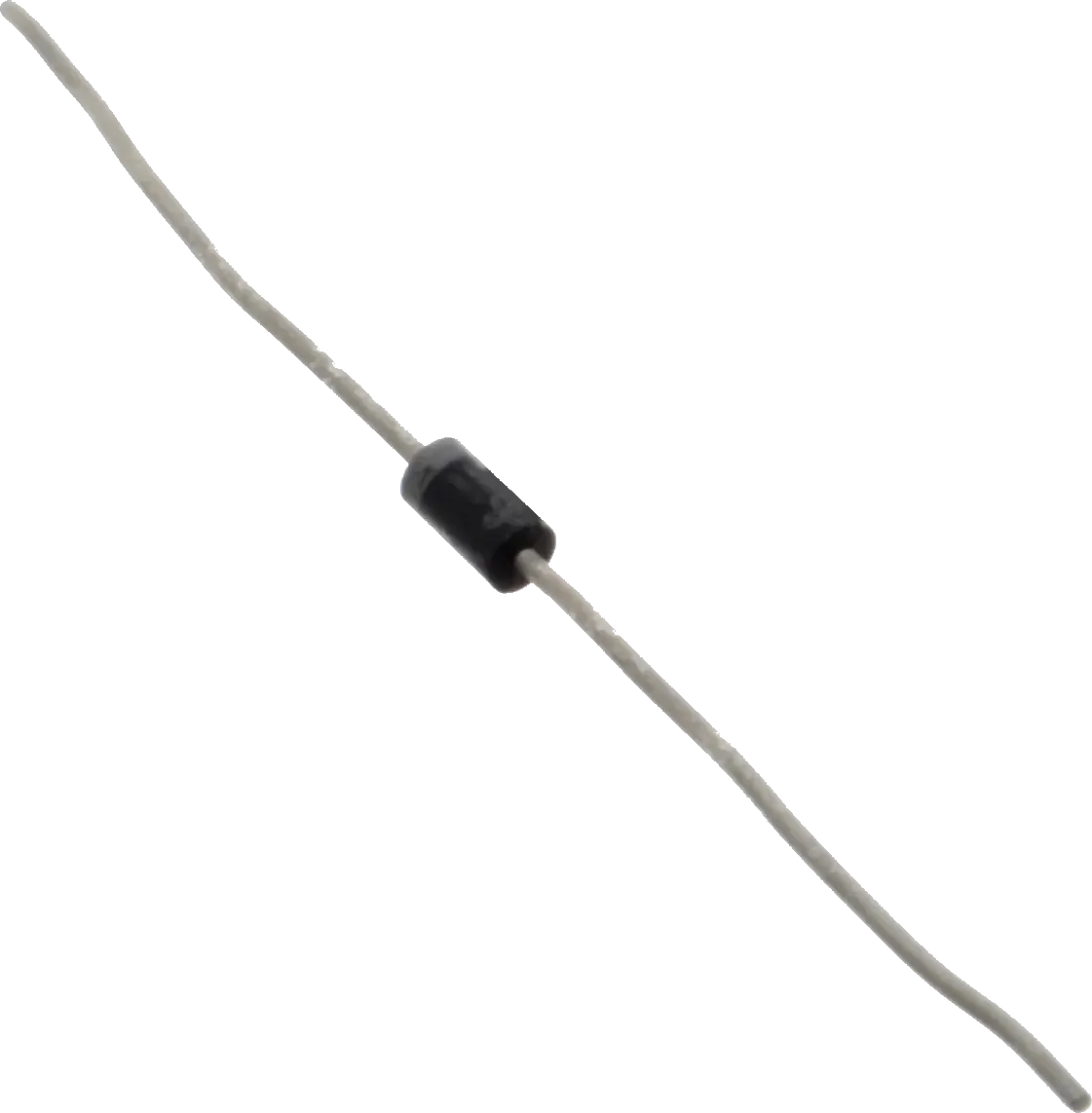
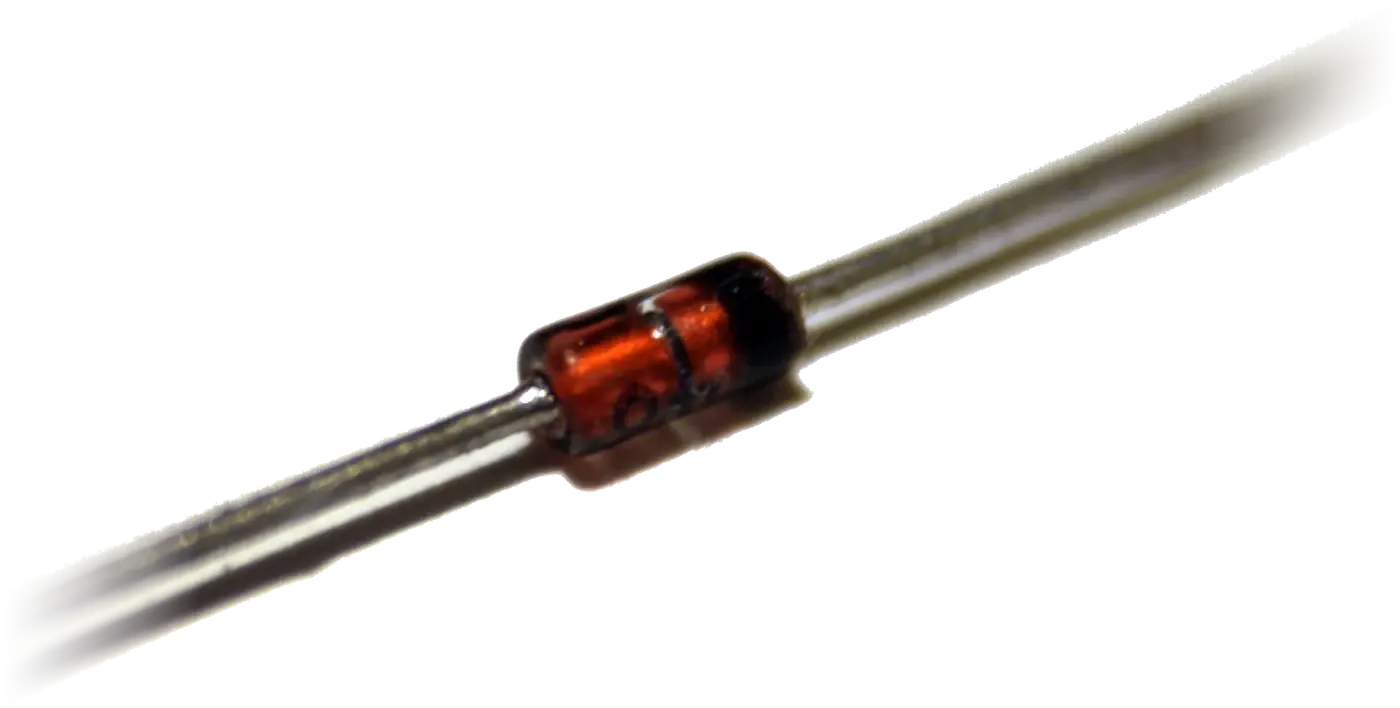
What does a diode do?
A diode lets current flow in one direction — from anode to cathode — and blocks it in the other. That one-way behaviour is what turns AC into DC, protects circuits from a supply connected the wrong way round, and steers signals.
The cathode end is usually marked with a band on the body. Fit a diode backwards and it conducts when it should block, so the circuit either fails to work or is damaged.
What are the common types of diode?
Most requirements fall into one of these families. Each is built for a different job, so the type matters before any rating does.
| Type | Used for | Key details |
|---|---|---|
| Rectifier | Turning AC into DC; reverse-polarity protection | Forward current, reverse voltage |
| Fast or ultrafast recovery | Switching power supplies and high-frequency circuits | Recovery time, current, voltage |
| Schottky | Low-loss rectification and protection, often in switching supplies | Low forward voltage, reverse voltage |
| Signal / switching | Small-signal switching, logic and steering | Low current, fast switching |
| Zener | Voltage regulation, references and clamping | Zener voltage, power rating |
| TVS | Absorbing voltage spikes and surges | Stand-off and clamping voltage, surge rating |
Zener diodes behave quite differently from the rest — see Diode vs Zener diode for how.
Which voltage and current ratings matter?
Two ratings decide whether a standard diode survives in a circuit: the current it carries forwards and the voltage it must block in reverse.
Forward current
The average forward current rating is the continuous current the diode is designed to carry. Choose one comfortably above the circuit’s actual current — a diode running close to its limit runs hot.
Reverse voltage
The repetitive peak reverse voltage is the highest reverse voltage the diode can block. In a rectifier it has to be above the peak of the AC it sees, not just the RMS value. Higher-voltage parts are often used even in low-voltage circuits for exactly this margin.
Forward voltage drop
Every diode drops some voltage while conducting — around 0.6–0.7 V for a silicon diode, and less for a Schottky. In low-voltage and battery circuits that drop matters, and at higher currents it turns into heat.
Surge current
Rectifiers also take a brief surge when a supply is switched on. The peak surge current rating shows how much of that the diode can withstand.
Does switching speed matter?
Yes, in any circuit that switches quickly. A standard rectifier takes a moment to stop conducting when the voltage reverses — its reverse recovery time. At mains frequency that’s harmless; in a switching power supply running at tens or hundreds of kilohertz, a slow diode wastes energy and heats up.
- Mains-frequency rectification: standard rectifiers are usually fine.
- Switching supplies and high-frequency circuits: fast, ultrafast or Schottky types.
- Signal switching and logic: small signal diodes.
If the original is a fast or Schottky type, replace it with the same kind. A standard rectifier may fit the board but not the circuit.
Which package does it need?
The package has to fit the board and handle the heat.
- Through-hole (axial): a lead at each end, for boards drilled for leaded parts. The body generally grows with the current rating.
- Surface-mount (SMD): soldered onto pads, in a range of package sizes.
- Power packages: for higher currents, often bolted to a heatsink.
- Bridge rectifiers: four diodes in one package, for full-wave rectification.
For a replacement, match the package as well as the ratings.
Why does the exact part number matter?
A complete part number pins down the type, ratings and package at once. Two diodes that look identical can have very different ratings, and a partial number can match several different parts.
- Read the whole marking, including letters before and after the main number.
- If the marking is worn, a sharp, well-lit photo helps identify it.
- If the part appears on a circuit diagram or BOM, send that reference too.
Without a part number, the type, current, reverse voltage and package are enough to start identifying suitable options.
What should I send when enquiring for diodes?
- The complete part number, if it’s readable.
- The type — rectifier, fast-recovery, Schottky, signal, Zener or TVS.
- The forward current and reverse voltage — or, for a Zener, the Zener voltage and power rating.
- Whether switching speed matters in the circuit.
- The package: through-hole or SMD, and the size if known.
- The quantity, and a photo for a replacement.
V Bright Electronics India deals in diodes and Zener diodes as part of its electronic components range. Several diodes at once? Send them as a list — see How to prepare a BOM.
Key takeaways
- Choose the type for the job first: rectifier, fast, Schottky, signal, Zener or TVS.
- Match forward current and reverse voltage, with margin.
- Switching circuits need fast or Schottky diodes.
- Match the package to the board, as well as the ratings.
- A complete part number is the most reliable way to identify a replacement.