
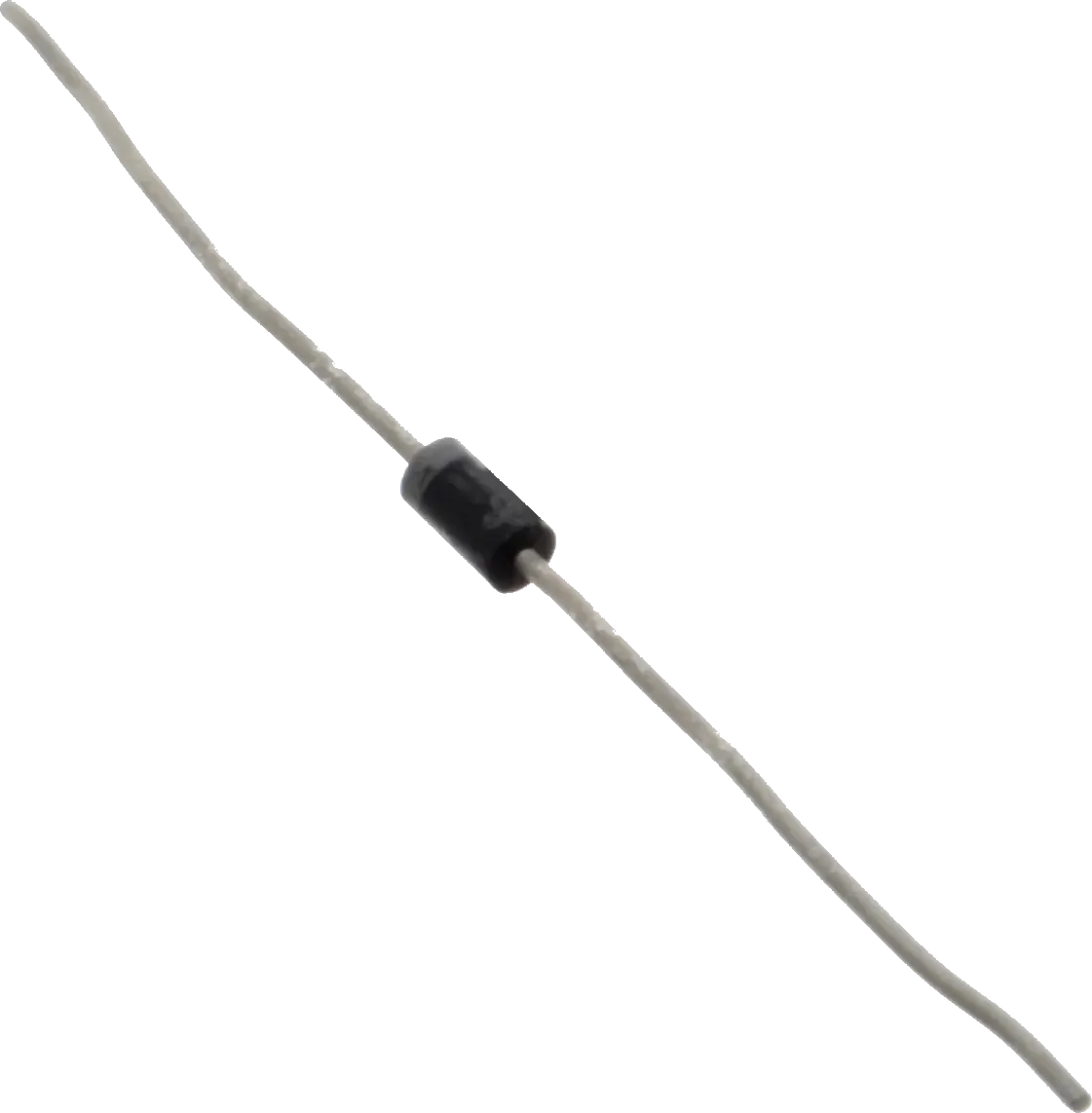
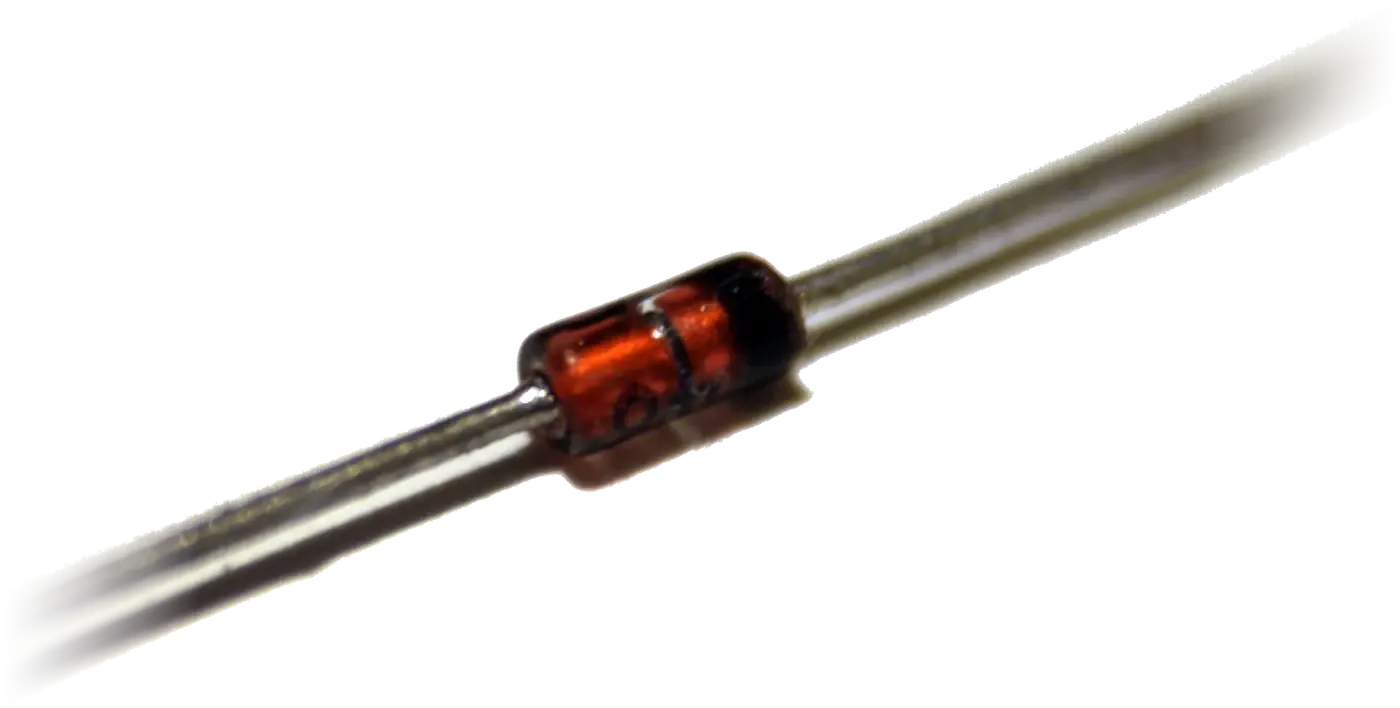
What does a standard diode do?
Forward-biased — anode more positive than cathode — a diode conducts, with a small voltage drop of around 0.6–0.7 V for a silicon diode. Reverse-biased, it blocks current up to its reverse voltage rating. Pushed beyond that rating, it breaks down and can be damaged.
- Rectification: turning AC into DC in power supplies and chargers.
- Reverse-polarity protection: stopping current if a supply is connected the wrong way round.
- Flyback protection: absorbing the voltage spike when a relay coil or other inductive load switches off.
- Signal steering and isolation between parts of a circuit.
What does a Zener diode do?
A Zener diode is made to break down in reverse at a precise, specified voltage, and to keep working there without damage as long as its power rating is not exceeded. With a series resistor to limit the current, the voltage across it stays close to its Zener voltage even as the supply or load changes.
- Simple voltage regulation for low-current circuits.
- Voltage references for comparators and measurement circuits.
- Overvoltage protection, clamping a line to a safe level.
Diode vs Zener diode: side by side
| Standard diode | Zener diode | |
|---|---|---|
| Works in | Forward direction (conducting) | Reverse breakdown, at its Zener voltage |
| Reverse breakdown | Avoided — it can damage the diode | Intended and controlled |
| Key ratings | Forward current and reverse voltage | Zener voltage and power rating |
| Typical uses | Rectification, protection, flyback | Regulation, references, clamping |
| Circuit symbol | Triangle and a straight bar | Triangle and a bar with bent ends |
Can a normal diode replace a Zener diode?
No. In reverse, a standard diode blocks until it fails rather than holding a set voltage, so it cannot do a Zener’s job. The reverse is also true: a Zener diode used as a rectifier would conduct backwards as soon as the voltage passed its Zener voltage.
Replace like with like. A Zener needs a Zener of the same voltage and an equal or higher power rating; a rectifier needs a diode with equal or higher current and reverse-voltage ratings, in a package that fits the board.
How can I tell them apart?
Both usually have a band marking the cathode. Zener diodes often come in small glass bodies, but body style alone is not reliable — the part number printed on the body, checked against its datasheet, is. When the marking is hard to read, a clear photo of it is the quickest way to identify the part.
What to include in a diode requirement
- The part number, if it is readable.
- The type — rectifier, fast-recovery, Schottky, signal or Zener.
- For a standard diode: the current and reverse-voltage ratings.
- For a Zener diode: the Zener voltage and power rating.
- The package — through-hole or SMD.
- The quantity, or a photo for a replacement.
For every common diode type and the ratings to check, see How to choose the right diode. Sending several parts? See How to prepare a BOM.
Key takeaways
- A standard diode conducts one way and blocks the other.
- A Zener diode is built to work in reverse breakdown at a set voltage.
- Diodes rectify and protect; Zeners regulate, reference and clamp.
- They are not interchangeable — replace like with like.
- Check the part number against its datasheet to identify either.