
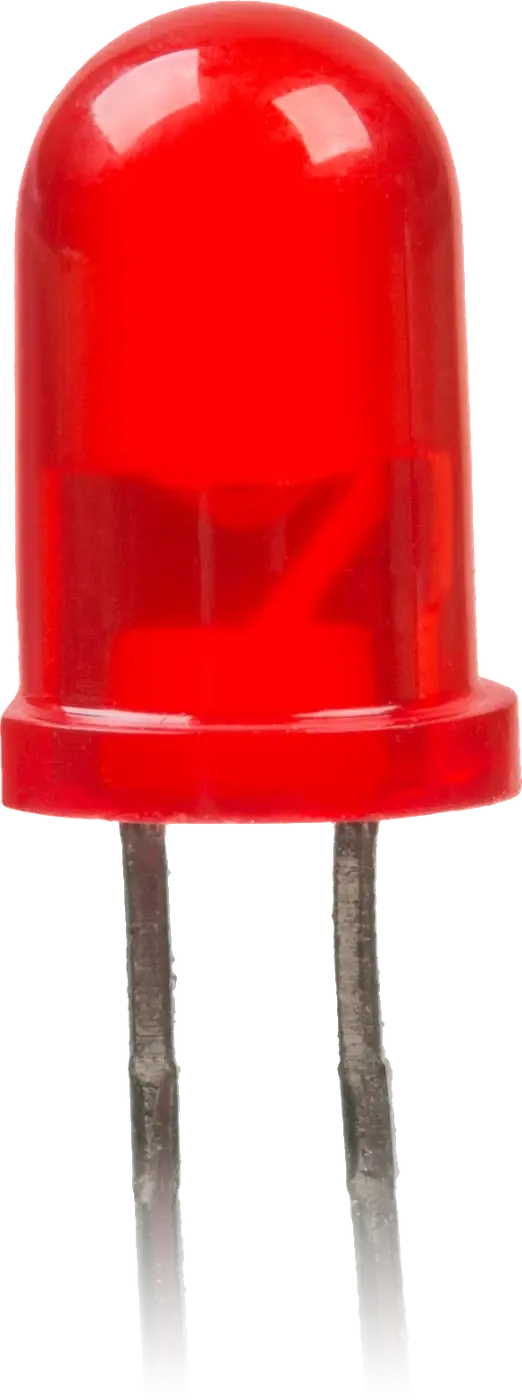
What is a DIP LED?
DIP (dual in-line package) LEDs are through-hole LEDs: their leads pass through holes in the circuit board and are soldered on the other side. The familiar domed 3 mm and 5 mm indicator LEDs are DIP LEDs.
On a new DIP LED the longer lead is usually the anode (+), and a flat edge on the rim marks the cathode (−).
What is an SMD LED?
SMD (surface-mount device) LEDs sit directly on pads on the surface of the board and are soldered there, usually by machine. Packages are named by size code: 0603, 0805 and 1206 for small chip LEDs, and codes such as 2835, 3528 and 5050 — the size in tenths of a millimetre — for larger lighting LEDs.
Polarity is marked on the package, often with a notch, a cut corner or a mark on the underside.
SMD vs DIP LEDs: side by side
| DIP LED | SMD LED | |
|---|---|---|
| Mounting | Leads through holes in the board | Soldered onto pads on the surface |
| Assembly | Hand or wave soldering | Usually machine-placed and reflow-soldered |
| Size | Larger, with leads | Very compact |
| Light | The lens shapes the beam; many are narrow-angle | Typically a wide viewing angle |
| Replacing by hand | Straightforward | Needs finer tools |
| Common uses | Indicators, panels, repair work, some outdoor display modules | LED strips, backlights, lighting, indoor and finer-pitch display modules |
Which is used in LED displays?
Both. DIP display modules have long been common for outdoor displays viewed from a distance. SMD modules, with red, green and blue in one package, suit indoor and finer-pitch displays and give a wider viewing angle. The installation, viewing distance and pitch decide which suits a project.
Numeric LED displays are their own case: see Common anode vs common cathode 7‑segment displays.
Which should I use for a repair or a new design?
For a repair, match the original: the same mounting type, size or package, colour and polarity. A board drilled for through-hole LEDs will not take SMD parts, and the reverse.
For a new design, through-hole suits hand assembly and prototypes; SMD suits compact boards and machine assembly.
What to include in an LED requirement
- SMD or DIP.
- The size or package code — for example 5 mm or 2835.
- The colour.
- The lens or viewing angle, if known.
- The quantity, and a photo for a replacement.
Key takeaways
- DIP LEDs are through-hole; SMD LEDs mount on the board surface.
- DIP suits hand soldering and indicators; SMD suits compact, machine-built boards.
- SMD LEDs usually spread light wider; many DIP LEDs focus it.
- Both are used in LED displays, for different installations.
- For a repair, match the mounting type, size, colour and polarity.