
What does a capacitor do?
A capacitor stores electrical charge and releases it again. In practice that means smoothing a supply, filtering out noise, blocking DC while passing AC signals, and setting timing in oscillators and timers.
Capacitance is measured in farads (F), but real values are far smaller: picofarads (pF), nanofarads (nF) and microfarads (µF). 1 µF = 1,000 nF = 1,000,000 pF.
What makes an electrolytic capacitor different?
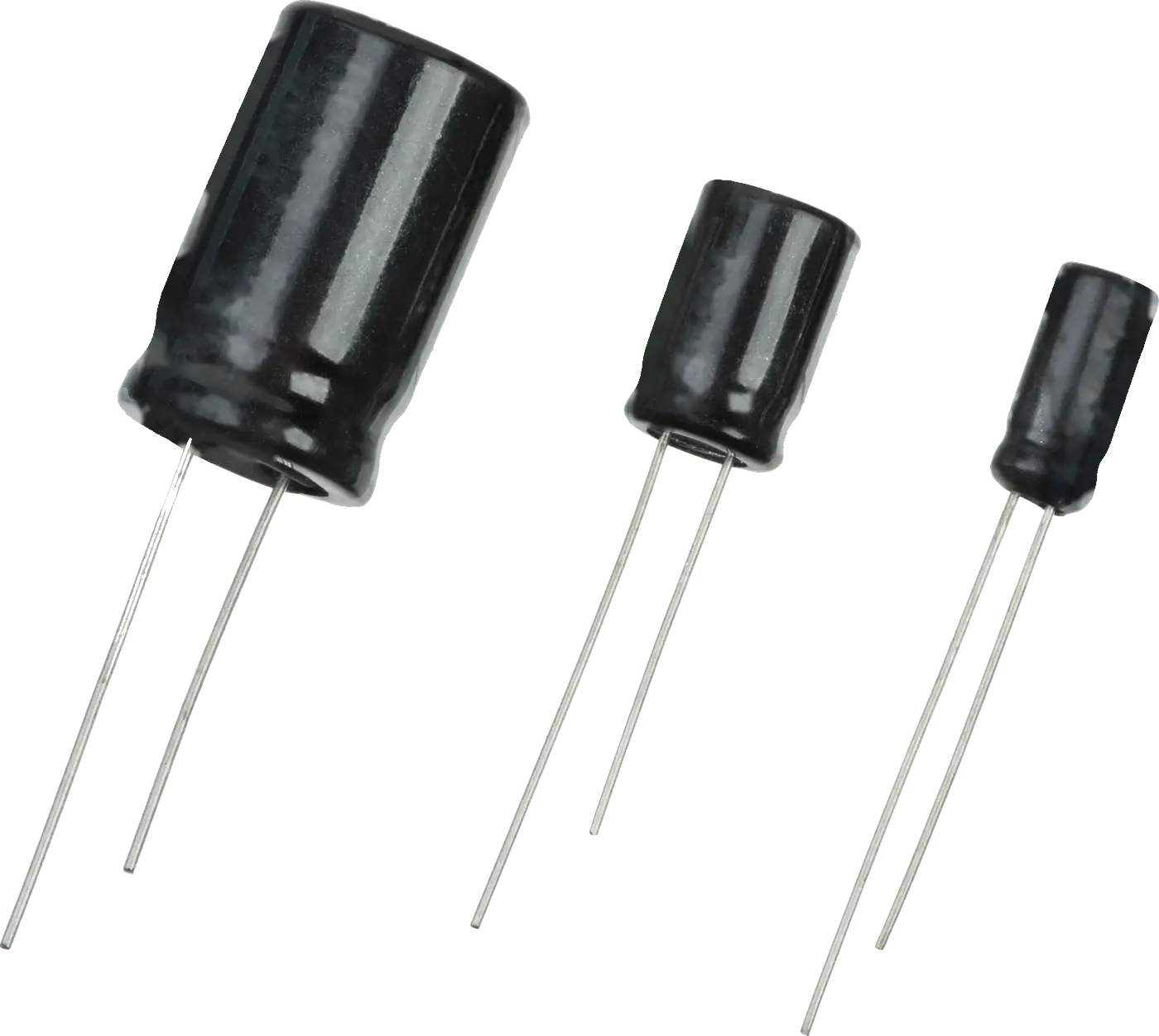
An aluminium electrolytic capacitor uses a very thin oxide layer and a liquid or gel electrolyte to pack a large capacitance into a small can. That makes it the usual choice when a circuit needs tens, hundreds or thousands of microfarads — to smooth the output of a power supply, for example.
The trade-offs: most electrolytics are polarised, they have wider tolerances than many other types, and they age — faster when they run hot. Their life is usually rated in hours at a maximum temperature on the datasheet.
| Ceramic | Film | Aluminium electrolytic | |
|---|---|---|---|
| Typical values | pF to µF | nF to µF | µF to thousands of µF |
| Polarised | No | No | Yes, most types |
| Size for the value | Small | Larger | Small for high values |
| Common uses | Decoupling, high-frequency filtering | Timing, filtering, AC and audio circuits | Power supply smoothing, bulk storage |
| Watch for | Some types change value with voltage and temperature | Larger bodies | Polarity, heat and ageing |
Are electrolytic capacitors polarised?
Most are. An aluminium electrolytic capacitor has a positive and a negative lead, and the positive lead must go to the more positive side of the circuit. Fitted backwards, it can overheat, bulge or vent.
- The stripe on the can, often printed with minus signs, marks the negative lead.
- On a new capacitor, the positive lead is longer.
- On the board, the footprint is usually marked + or has a shaded half on the negative side.
Bipolar (non-polarised) electrolytics are made for circuits where the voltage reverses, such as some audio crossovers. They’re marked NP or BP.
Where is each type used?
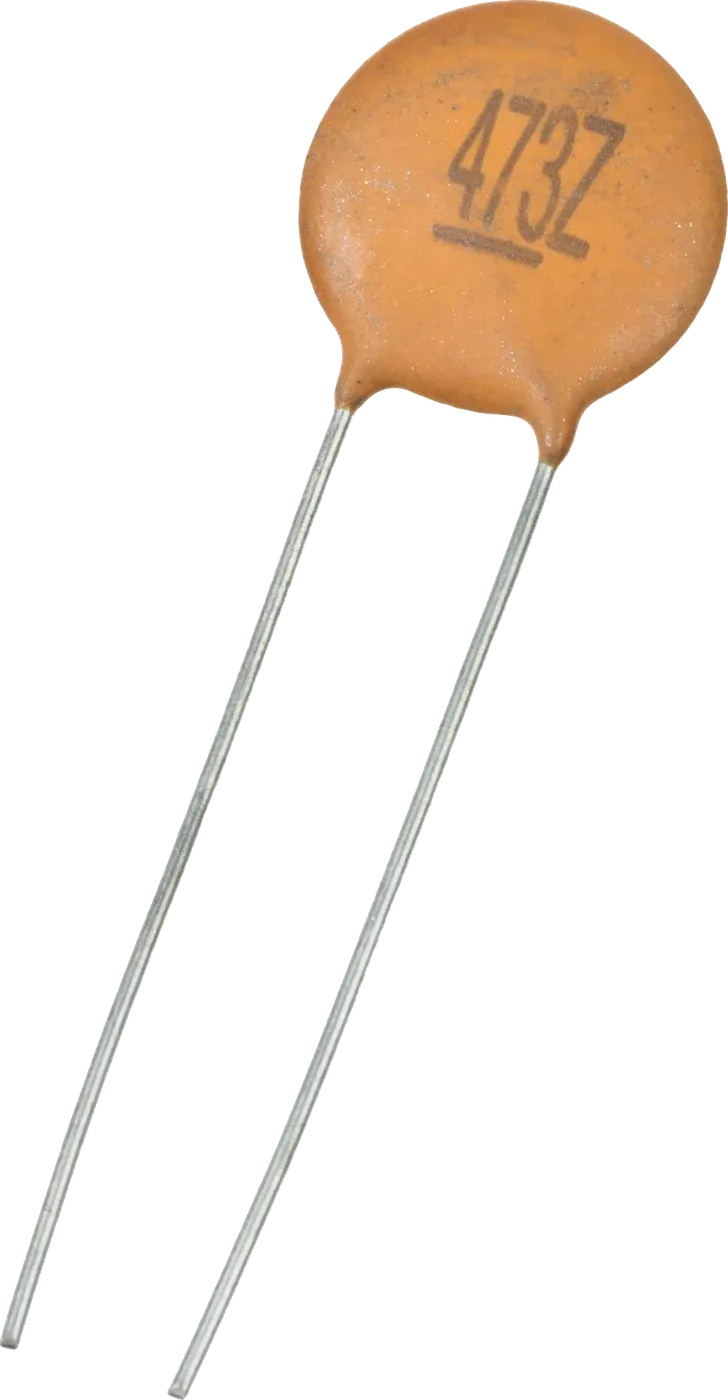
- Ceramic: decoupling beside ICs, high-frequency filtering and small timing capacitors — including small pF values.
- Film: timing, filtering and AC applications where stability matters.
- Electrolytic: smoothing and storage in power supplies, LED drivers, amplifiers and motor circuits.
A typical power supply uses both: large electrolytics smooth the rectified voltage, while small ceramics deal with high-frequency noise.
What capacitance and voltage rating do I need?
Capacitance
Use the value marked on the original or shown on the circuit diagram. For power supply smoothing, a slightly higher value is often acceptable; in timing and filter circuits the value sets the behaviour, so match it.
Voltage rating
The voltage rating must be above the highest voltage the capacitor will see. Choosing with margin — a 25 V part on a 12 V rail, for example — is common practice. A higher voltage rating is generally a safe substitute if it fits; a lower one is not.
Temperature and life
Electrolytics are rated for a maximum temperature, commonly 85 °C or 105 °C. In hot equipment such as power supplies and LED drivers, a 105 °C part with a long rated life is often preferred.
How do I identify a replacement?
- Note the type: electrolytic, ceramic or film.
- Read the capacitance (µF, nF or pF) and the voltage rating printed on it.
- For an electrolytic, note the temperature rating, the can’s diameter and height, and the lead spacing.
- Check the mounting: radial (both leads at one end), axial (one at each end) or SMD.
- Take a clear photo showing the markings and the stripe.
Small ceramic capacitors often carry a three-digit code instead of a value: 104 means 10 followed by four zeros, in picofarads — 100,000 pF, or 100 nF.
A bulging, leaking or discoloured electrolytic has failed. Replace it with the same capacitance, an equal or higher voltage rating and the correct polarity — and if it ran hot, find out why.
What to include in a capacitor requirement
- The type: ceramic, film or electrolytic.
- The capacitance and voltage rating.
- For electrolytics: the temperature rating and can size.
- The mounting: radial, axial or SMD.
- The quantity, and a photo for a replacement.
V Bright Electronics India deals in capacitors, electrolytic capacitors and pF capacitors.
Key takeaways
- Electrolytics give high capacitance in a small can; ceramics and film suit smaller values.
- Most electrolytics are polarised: the stripe marks negative.
- Match the capacitance; use an equal or higher voltage rating.
- In hot equipment, prefer 105 °C electrolytics.
- Note the size and mounting as well as the value for a replacement.