
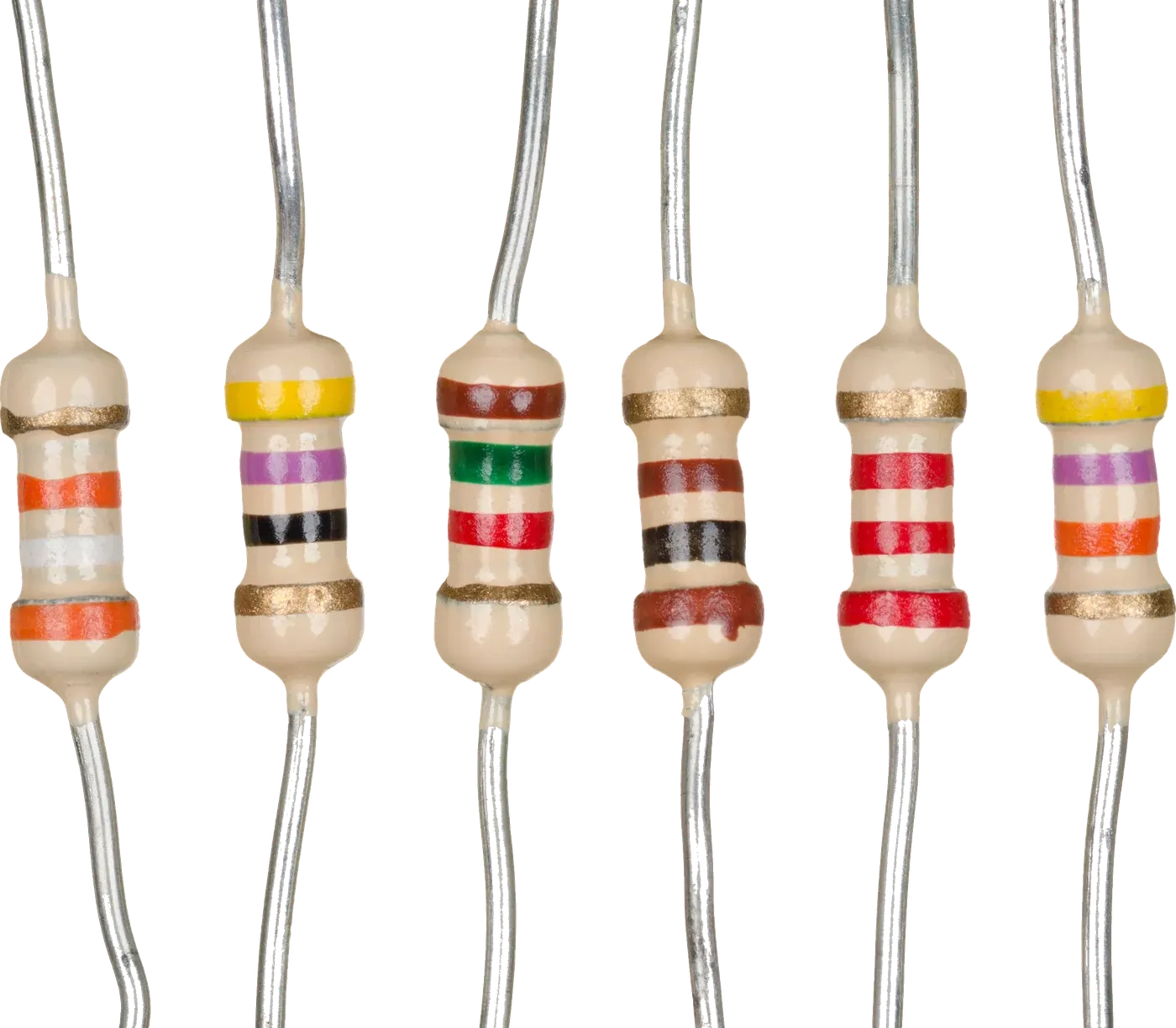
What does a resistor do?
A resistor limits the current flowing in a circuit. It sets the current through an LED, divides a voltage, pulls a signal to a known level, and sets the gain or timing of a circuit.
The relationship is Ohm’s law: voltage = current × resistance. With 5 V across a 1 kΩ resistor, 5 mA flows.
What are the common types of resistor?
| Type | Typical use | Notes |
|---|---|---|
| Carbon film | General-purpose through-hole use | Economical; common in simple designs |
| Metal film | Precision and low-noise circuits | Tighter tolerances, more stable with temperature |
| Metal oxide | Higher-power general use | Copes well with heat; often used at higher wattages |
| Wirewound | High power and current sensing | Handles more power; larger bodies |
| SMD chip | Compact surface-mount boards | Marked with a number code, or unmarked on small sizes |
| Variable (potentiometer) | Adjustable settings | The marked value is the maximum resistance |
What is the resistance value?
Resistance is measured in ohms (Ω). Values use prefixes: 4.7 kΩ is 4,700 Ω and 1 MΩ is 1,000,000 Ω. On drawings and parts lists, the letter often stands in for the decimal point — 4K7 means 4.7 kΩ, and 2R2 means 2.2 Ω.
Resistors are made in standard series of preferred values rather than every possible number. If a calculation gives an unusual value, the nearest standard value is normally used.
What does tolerance mean?
Tolerance is how far the actual resistance may be from the marked value. A 1 kΩ resistor at ±5% can measure anywhere from 950 Ω to 1,050 Ω; at ±1%, from 990 Ω to 1,010 Ω.
Most general circuits are fine with ±5%. Measurement, reference and timing circuits often need ±1% or better. A tighter tolerance can replace a looser one; the reverse can change how a circuit behaves.
What power rating do I need?
The power rating is the heat a resistor can safely dissipate, in watts. Common through-hole ratings include ¼ W, ½ W, 1 W and 2 W, and the body generally gets larger as the rating goes up.
Power = voltage² ÷ resistance (or current² × resistance). Choose a rating comfortably above the result — many designers allow at least double — because a resistor near its limit runs hot.
Example: 12 V across 1 kΩ dissipates 12² ÷ 1,000 = 0.144 W. A ½ W resistor gives comfortable margin; a ¼ W part would run closer to its limit.
For a replacement, never fit a lower power rating than the original.
Through-hole or SMD?
Through-hole resistors have wire leads and suit hand soldering, prototypes and repair. SMD resistors are small chips soldered onto pads, named by size code — 0402, 0603, 0805 and 1206 are common. Larger SMD sizes generally handle more power.
Match the board: holes need through-hole resistors, and an SMD footprint needs the same size code.
How do I read resistor colour bands?
On a 4‑band resistor, the first two bands are digits, the third is the multiplier (how many zeros to add) and the fourth is the tolerance.
| Colour | Digit | Multiplier | Tolerance |
|---|---|---|---|
| Black | 0 | ×1 | — |
| Brown | 1 | ×10 | ±1% |
| Red | 2 | ×100 | ±2% |
| Orange | 3 | ×1k | — |
| Yellow | 4 | ×10k | — |
| Green | 5 | ×100k | ±0.5% |
| Blue | 6 | ×1M | ±0.25% |
| Violet | 7 | ×10M | ±0.1% |
| Grey | 8 | — | — |
| White | 9 | — | — |
| Gold | — | ×0.1 | ±5% |
| Silver | — | ×0.01 | ±10% |
5‑band resistors have three digit bands before the multiplier, for more precise values. Read from the end where the bands are grouped together; the tolerance band usually sits slightly apart. If you’re unsure, measure the resistor out of circuit with a multimeter, or send a clear photo.
SMD resistor codes
SMD resistors use number codes. In a 3‑digit code, the first two digits are the value and the third is the number of zeros: 472 is 4,700 Ω (4.7 kΩ). A 4‑digit code works the same way with three digits: 1002 is 10,000 Ω (10 kΩ). R marks a decimal point: 4R7 is 4.7 Ω.
What details should I provide for a resistor requirement?
- The resistance value, in Ω, kΩ or MΩ.
- The tolerance — for example ±5% or ±1%.
- The power rating in watts.
- The type, if it matters — metal film, wirewound and so on.
- The package: through-hole, or the SMD size code.
- The quantity of each value — or a photo for a replacement.
V Bright Electronics India deals in resistors as part of its electronic components range. For several values, list one per line — see How to prepare a BOM.
Key takeaways
- A resistor is defined by its value, tolerance and power rating.
- Tighter tolerance can replace looser — not the other way round.
- Allow generous margin on power, and never fit a lower rating.
- Colour bands: two digits, a multiplier and a tolerance on a 4‑band resistor.
- SMD codes: 472 means 4.7 kΩ; R marks a decimal point.